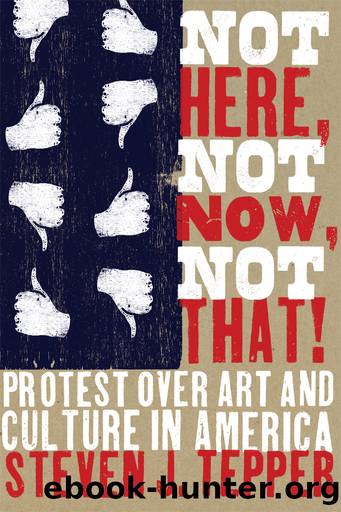
Not Here, Not Now, Not That! by Steven J. Tepper
Author:Steven J. Tepper [Tepper, Steven J.]
Language: eng
Format: epub
Tags: Social Science, General, Sociology, Political Science, Censorship, Art
ISBN: 9780226792880
Google: sihbUd29_iQC
Publisher: University of Chicago Press
Published: 2011-06-15T02:39:31+00:00
Web of Connections
Theories about the culture wars suggest that there is a web of concerns connecting what might appear on the surface to be unrelated issues, including arts and culture, education reform, abortion, gay rights, and popular entertainment (Hunter 1991). After Pat Buchanan announced at the 1992 Republic National Convention that America was in the midst of a culture war, journalists and activists alike have been quick to group together a diverse array of social and cultural conflicts as evidence of Buchananâs claim. As Hunter describes it, the issues motivating activists in the culture wars are rooted in differing worldviewsâfundamentalism and orthodoxy versus secularism and relativism. Cities of contention stand out from other kinds of cities in the extent to which activists link conflicts to larger issues facing the nation or their communities.
Many protesters linked arts conflicts to a âgay agendaâ that stood in opposition to American âfamily values.â Others more broadly claimed that the âwrongâ culture has the power to undermine American life. Charlotteâs Rev. Joseph Chambers, a stalwart opponent of Angels in America, said that the play is part of a larger group of events that âshould be an example to all traditional Americans of what the radical gay community and those who support them intend for this nation.â He added, âThis drama is not about art or eight seconds of nudity. It is about the destruction of moral consciousnessâ (Chambers 1996). Harry Reeder, a local Charlotte minister, wrote an opinion editorial claiming that the arts community promoted âan aggressive cultural agenda that is absolutely committed to the total reconstruction of our cultureâ (Reeder 1997). In Denver a teacher who was fired for showing an R-rated film to high school studentsâBertolucciâs 1900âlinked the disciplinary action to âan anxious community worried about seemingly out-of-control children, low academic scores, increasing banality of popular culture as seen on the Springer show, and as seen in the mediaâ (Simpson 1998).
In addition to concerns about the âgay agendaâ and general moral decay, several conflicts were linked to fears of secular humanism creeping into the classroom. In Fort Worth the attack against the book The Last Mission was made from the same group (PAGE) that also opposed critical thinking, cooperative learning, multiculturalism, and whole language learning. The battle over The Last Mission, which contains profanity, became an opportunity to oppose educational materials and teaching styles understood as undermining traditional education. As noted above, members of PAGE linked the book controversy to notions of âcritical thinking,â dangerous ideas of âliberating childrenâ from their parents, and the broader influence of âcommunism.â The conflicts over books in Forth Worth also revealed the fear that national outsiders, for example, âliberalsâ representing the federal government, were trying to impose their values on local schools. In one exchange when a school board member defended the selection of library booksâincluding The Last Missionâby pointing out the professional training of school officials, parents erupted with boos and jeers, dismissing the judgment of national experts. In Dallas parents objected to the school boardâs
Download
This site does not store any files on its server. We only index and link to content provided by other sites. Please contact the content providers to delete copyright contents if any and email us, we'll remove relevant links or contents immediately.
The Secret History by Donna Tartt(19034)
The Social Justice Warrior Handbook by Lisa De Pasquale(12183)
Thirteen Reasons Why by Jay Asher(8885)
This Is How You Lose Her by Junot Diaz(6873)
Weapons of Math Destruction by Cathy O'Neil(6261)
Zero to One by Peter Thiel(5784)
Beartown by Fredrik Backman(5734)
The Myth of the Strong Leader by Archie Brown(5495)
The Fire Next Time by James Baldwin(5426)
How Democracies Die by Steven Levitsky & Daniel Ziblatt(5211)
Promise Me, Dad by Joe Biden(5141)
Stone's Rules by Roger Stone(5080)
A Higher Loyalty: Truth, Lies, and Leadership by James Comey(4947)
100 Deadly Skills by Clint Emerson(4915)
Rise and Kill First by Ronen Bergman(4776)
Secrecy World by Jake Bernstein(4739)
The David Icke Guide to the Global Conspiracy (and how to end it) by David Icke(4697)
The Farm by Tom Rob Smith(4501)
The Doomsday Machine by Daniel Ellsberg(4482)
